

Aston Martin remains one of the most distinctive names in the luxury-performance world because it has never relied on speed alone. Since 1913, the brand has built its identity around elegant design, grand touring comfort, motorsport credibility, and emotional performance. That character still shows up clearly in the modern road-car lineup, from the DB12 and Vantage to the Vanquish, DBX, and Valhalla.
For owners of modern Aston Martin models, maintenance decisions often matter just as much as headline performance figures. A quality drop-in panel filter can be part of that conversation when it is designed to work in the factory airbox, support strong airflow, and offer long-term serviceability. BMC’s racing heritage dates back to 1973, with Formula 1 cooperation with Scuderia Ferrari beginning in 1995, and the company says that knowledge was transferred into its aftermarket replacement-filter program in 1996.
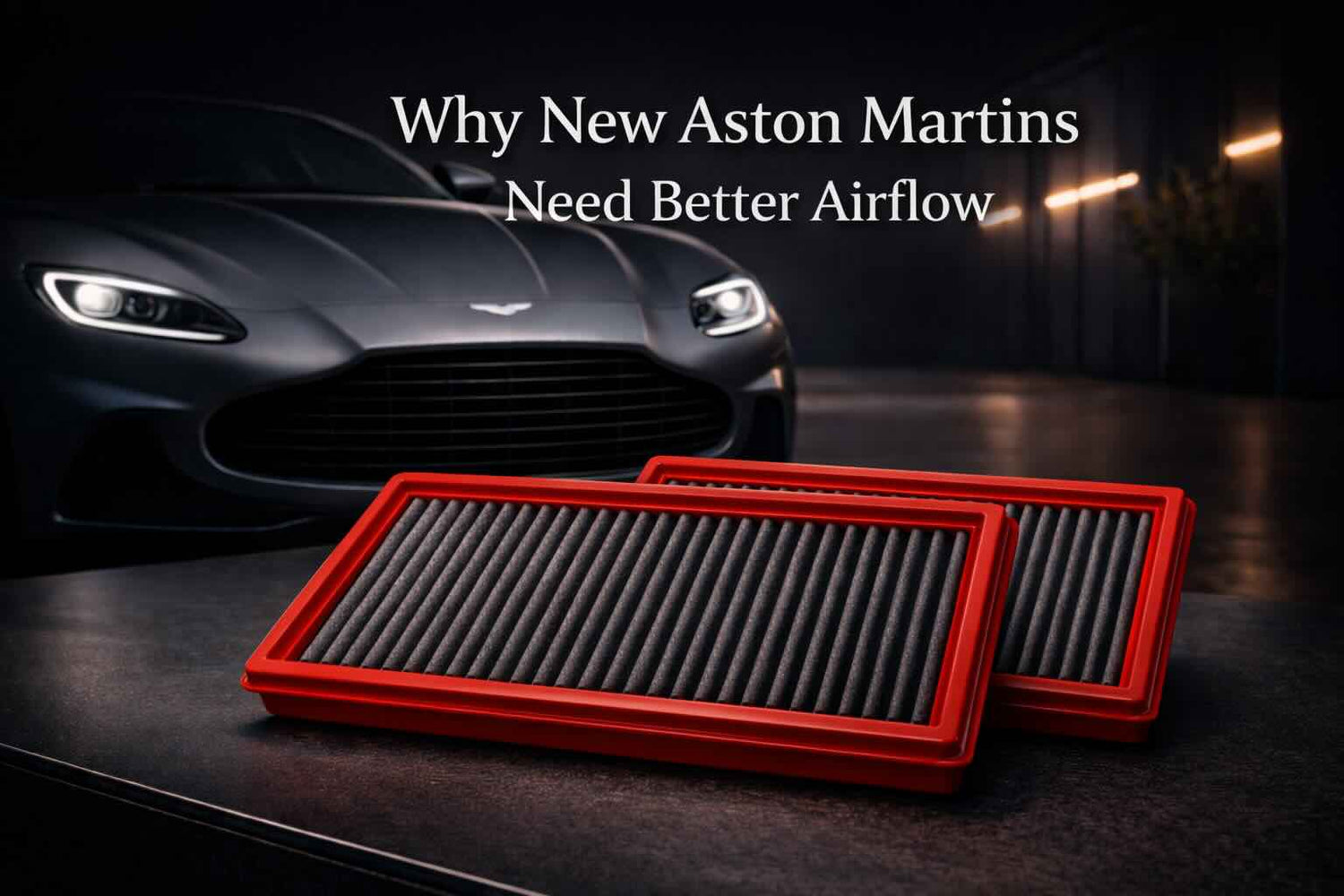
For Aston Martin applications including DB11, DB12, DBS Superleggera, Vantage, and Vanquish, the BMC FB305/01 air filter is a washable, reusable, full-moulded replacement panel filter designed for use in the original airbox. BMC describes its replacement filters as a way to improve airflow and maintain efficient filtration without promising guaranteed horsepower gains from a filter alone. For Aston Martin owners who value quality, serviceability, and subtle OEM-style upgrades, that is the right way to look at it.
- Why Aston Martin heritage still matters
- How the modern Aston Martin lineup reflects that identity
- Why airflow and maintenance matter for Aston Martin owners
- Why BMC fits the Aston Martin ownership story
- Benefits of a BMC replacement air filter
- Aston Martin fitment and what owners should check
- Frequently asked questions
- Final thoughts
Aston Martin occupies a rare place in the automotive world. Plenty of brands can build a fast car. Fewer can make that car feel like an event before the engine is even started. That is the territory Aston Martin has spent more than a century defending: performance that feels elegant, engineering that still feels emotional, and design that never completely surrenders to trends.
That balance is exactly why Aston Martin continues to stand out. The brand does not build bare-knuckle sports cars in the purest sense, and it does not build isolated luxury cars either. It lives in the space between the two. The best Aston Martins feel capable, dramatic, and refined at the same time, which is not an easy formula to maintain in a market crowded with high-horsepower machines.
For modern owners, that identity also shapes the way upgrades and maintenance choices are viewed. Aston Martin buyers are usually not looking for the loudest or cheapest modification available. They tend to value components that respect the original engineering, preserve the car’s character, and add practical long-term value. That is where a premium drop-in air filter can make sense.
Why Aston Martin heritage still matters
Aston Martin was founded in 1913 by Lionel Martin and Robert Bamford, and over the decades it developed a reputation that goes well beyond raw numbers. The company’s identity was heavily shaped by David Brown after he acquired the business in 1947, and the “DB” initials that define so many of the marque’s best-known road cars still come directly from his name. That lineage remains central to how Aston Martin presents itself today.
Motorsport also plays a real part in that story. Aston Martin’s DBR1 secured the company’s first outright 24 Hours of Le Mans win in 1959, one of the most important achievements in the brand’s history. That victory helped cement Aston Martin’s place in world sportscar racing and reinforced the brand’s image as something more than a stylish grand touring manufacturer.
That heritage matters because it still shapes buyer expectations. People expect an Aston Martin to feel special, not merely fast. They expect beauty, presence, and a sense of occasion. They also expect the engineering to support long-distance confidence, not just short bursts of speed. Those expectations carry forward into the modern lineup.
How the modern Aston Martin lineup reflects that identity
Aston Martin’s current road-car lineup shows a brand that is moving forward without cutting itself loose from its roots. The DB12, Vantage, Vanquish, DBX, and Valhalla each interpret the marque’s identity differently, but the theme is still recognizable: performance with character.
DB12
The DB12 represents Aston Martin’s current vision of the modern grand tourer. The company positions it as a “Super Tourer,” and the formula is familiar in the best way: a hand-built twin-turbo V8, strong performance, luxurious presentation, and sharper dynamics than the traditional GT category used to imply. It is meant to cover distance quickly while still feeling like a proper driver’s car.
Vantage
The Vantage remains the more focused and direct member of the range. Aston Martin describes it as a front-engine, rear-wheel-drive sports car, which is a layout that still holds enormous appeal for enthusiasts who want balance, engagement, and a more immediate connection with the chassis. In a world full of very fast cars that can feel strangely remote, that matters.
Vanquish
The Vanquish sits at the more dramatic end of the spectrum. Long-hood proportions, flagship intent, and V12 power give it the kind of theatrical presence Aston Martin has always done well. It exists partly because some performance cars are supposed to be rationally unnecessary. That is part of the charm.
DBX and Valhalla
The DBX and Valhalla show that Aston Martin is not stuck looking backward. DBX gives the brand a serious presence in the performance-SUV market, while Valhalla pushes Aston Martin into the hybrid supercar conversation. Together they show a company willing to evolve without becoming generic.
For owners and enthusiasts, the important point is not just that Aston Martin sells different types of vehicles. It is that the company still tries to preserve a recognizable personality across them. That continuity is part of what makes the brand compelling, and it also explains why owners tend to be selective about the parts they install.
Why airflow and maintenance matter for Aston Martin owners
Modern Aston Martin models are highly developed performance machines. Their engines rely on carefully managed airflow, fuel delivery, temperature control, and calibration strategy to deliver the refinement and power the brand is known for. Even when a vehicle is completely stock, the condition and quality of intake components still matter.
That does not mean every intake-related product deserves a place on the car. Quite the opposite. Owners are usually better served by upgrades that work within the factory airbox and preserve the original system layout rather than chasing exaggerated promises. A quality replacement panel filter fits that philosophy much better than a one-size-fits-all performance pitch.
For many owners, the appeal is straightforward: a reusable drop-in filter can offer long-term serviceability, maintain compatibility with the stock intake system, and reduce dependence on disposable paper elements. On a premium performance car, that is a sensible ownership consideration.
Why BMC fits the Aston Martin ownership story
BMC’s background helps explain why the brand is often associated with European performance applications. The company traces its origins to 1973 and says its motorsport development included early racing activity before cooperation with Scuderia Ferrari Formula 1 began in 1995. According to BMC, the knowledge gained from Formula 1 was then transferred into its aftermarket replacement-filter program in 1996.
That history matters because it gives BMC a more credible position than generic aftermarket brands that simply attach racing language to ordinary products. For Aston Martin owners, the fit feels natural: a premium European performance brand paired with a filter manufacturer whose identity is tied to high-performance filtration and motorsport development.
For shoppers looking at available options, the Aston Martin BMC air filter collection provides a clear starting point. One of the most relevant products for modern Aston Martin applications is the BMC FB305/01 air filter, which is listed for fitments including DB11, DB12, DBS Superleggera, Vantage, and Vanquish applications.
Benefits of a BMC replacement air filter
The strongest case for a BMC replacement filter is not hype. It is practicality.
BMC states that its replacement filters are designed to install in the original airbox in place of the OEM paper filter. The company describes the construction as multi-layered cotton gauze soaked in low-viscosity oil, supported by epoxy-coated alloy mesh and a full-moulded one-piece frame. According to BMC, this design is intended to support increased airflow while maintaining efficient filtration.
That matters for owners because it frames the upgrade correctly. A replacement panel filter should not be treated as a miracle power adder. BMC itself does not present its replacement filters as a guaranteed horsepower solution on their own. Instead, the practical advantages are easier to understand and easier to defend: reusable service life, compatibility with the stock airbox, and a design intended to reduce the restriction associated with conventional disposable paper media.
There is also a long-term ownership angle. A washable and reusable filter can be cleaned and reinstalled using the proper BMC regeneration kit instead of being discarded and replaced like a standard paper filter. For Aston Martin owners who prefer quality parts and a more durable maintenance approach, that is a genuine advantage.
Just as importantly, this is the kind of upgrade that respects the car. It does not ask the owner to abandon the original intake design or make the vehicle something it was never meant to be. It is a subtle, OEM-style improvement, and that is often exactly the point.
Aston Martin fitment and what owners should check
Fitment always matters more than enthusiasm. Before ordering any air filter for an Aston Martin, compatibility should be verified carefully by application and, ideally, by VIN.
BMC’s published FB305/01 compatibility information includes several Aston Martin applications, including DB11, DB12, DBS Superleggera, Vantage, and Vanquish fitments. For these Aston Martin applications, BMC also specifies that two filters are required per vehicle. That is an important detail and one buyers should not overlook.
Owners who want a simple starting point can browse the Aston Martin BMC air filter collection and then confirm the specific application before purchase. When working with premium vehicles, getting the fitment right the first time is worth the extra minute.
Are BMC air filters good for Aston Martin?
BMC filters are a natural fit for Aston Martin owners who want an OEM-style replacement designed for the factory airbox, along with reusable service life and a motorsport-rooted brand background. The best choice always depends on correct fitment for the specific model and VIN.
Does a BMC air filter add horsepower to an Aston Martin?
BMC does not present a replacement panel filter as a guaranteed horsepower upgrade on its own. The more accurate way to view it is as a reusable filter designed to support strong airflow and efficient filtration within the stock airbox.
Which Aston Martin models use the BMC FB305/01?
BMC’s published compatibility information for the FB305/01 includes multiple Aston Martin applications such as DB11, DB12, DBS Superleggera, Vantage, and Vanquish. Fitment should still be verified before ordering.
Do Aston Martin applications require two filters?
Yes. BMC specifies that the relevant Aston Martin FB305/01 applications require two filters per vehicle.
Is a washable air filter worth it for Aston Martin owners?
For many owners, yes. A washable filter can be a smart long-term maintenance choice because it is reusable, designed for the original airbox, and avoids repeated disposal of paper filter elements.
Final thoughts
Aston Martin still matters because it continues to build performance cars with personality. The brand’s appeal has never been limited to output figures or top-speed claims. It comes from the way heritage, design, engineering, and emotion are blended into something that feels distinct in a crowded market.
That is also why the right air filter upgrade belongs in the ownership conversation. Not because it turns the car into something else, but because it fits the priorities many Aston Martin owners already have: quality, subtlety, serviceability, and respect for the original engineering. A product like the BMC FB305/01 air filter makes sense when it is understood as a premium reusable replacement filter for the stock airbox rather than a flashy shortcut to performance.
For owners of modern Aston Martin models who value thoughtful maintenance and understated upgrades, that is a compelling reason to take a closer look.
- Aston Martin’s identity is still built around heritage, elegant design, motorsport credibility, and emotional performance.
- The modern lineup, including DB12, Vantage, Vanquish, DBX, and Valhalla, continues that formula in different ways.
- Modern Aston Martin owners often prefer subtle OEM-style upgrades over exaggerated performance claims.
- BMC’s background includes motorsport roots, Ferrari Formula 1 cooperation beginning in 1995, and aftermarket transfer of that knowledge in 1996.
- The BMC FB305/01 is a washable, reusable replacement panel filter listed for multiple Aston Martin applications, with two filters required per vehicle on those fitments.
Always verify Aston Martin fitment by VIN before ordering. BMC’s published FB305/01 compatibility list includes multiple DB11, DB12, DBS Superleggera, Vantage, and Vanquish applications, and BMC specifies that these Aston Martin applications require two filters per vehicle.



Leave a comment
This site is protected by hCaptcha and the hCaptcha Privacy Policy and Terms of Service apply.