


Executive summary: Performance air filters can increase horsepower when the stock filter/airbox is a measurable restriction at the engine’s airflow demand. Most “drop-in” gains are modest, but reduced restriction can improve repeatability under sustained high load—especially on high-output and turbocharged platforms. This guide explains the physics (pressure drop and pumping loss), how filters are tested (flow bench + ISO 5011), what good dyno methodology looks like, how turbo compressor efficiency is affected by inlet restriction, and how to set realistic expectations.
Shop vehicle-specific BMC replacement filters | Filtration technology & testing overview | Cleaning & re-oiling best practices
The quick answer (with the honest caveats)
Yes—sometimes. A performance air filter can increase horsepower if the factory filter is restrictive at the engine’s operating airflow. No—often not by much on stock daily drivers where the OEM system already flows well.
The most defensible technical statement is this: a performance filter may reduce pressure drop across the intake tract. Whether that reduction becomes measurable horsepower depends on airflow demand, engine control strategy, and the rest of the intake system.
What actually changes horsepower
Engines make power by burning fuel with oxygen. More oxygen (air mass) enables more fuel to burn—within knock, temperature, and fueling limits. Air mass entering cylinders is a function of:
- Air density (temperature, pressure)
- Engine airflow demand (displacement, RPM, volumetric efficiency)
- Restriction in the intake/exhaust path (pressure losses)
An air filter can only influence the last item. If the filter is not a bottleneck, it won’t unlock power by itself.
Pressure drop, restriction, and pumping loss (with math)
Restriction is measured as pressure drop (ΔP), often in inH2O or Pa. The energy required to move fluid through a restriction scales with both ΔP and flow rate.
A useful engineering approximation is:
Power (W) ≈ ΔP (Pa) × Q (m³/s)
That relationship (power equals pressure difference times volumetric flow) is the same core idea used in pump power and fluid power derivations.
Translation: If you reduce restriction and the engine is airflow-limited, you may reduce pumping losses and/or slightly increase delivered air mass. But “big gains” require the filter to be a real bottleneck at the tested operating point.
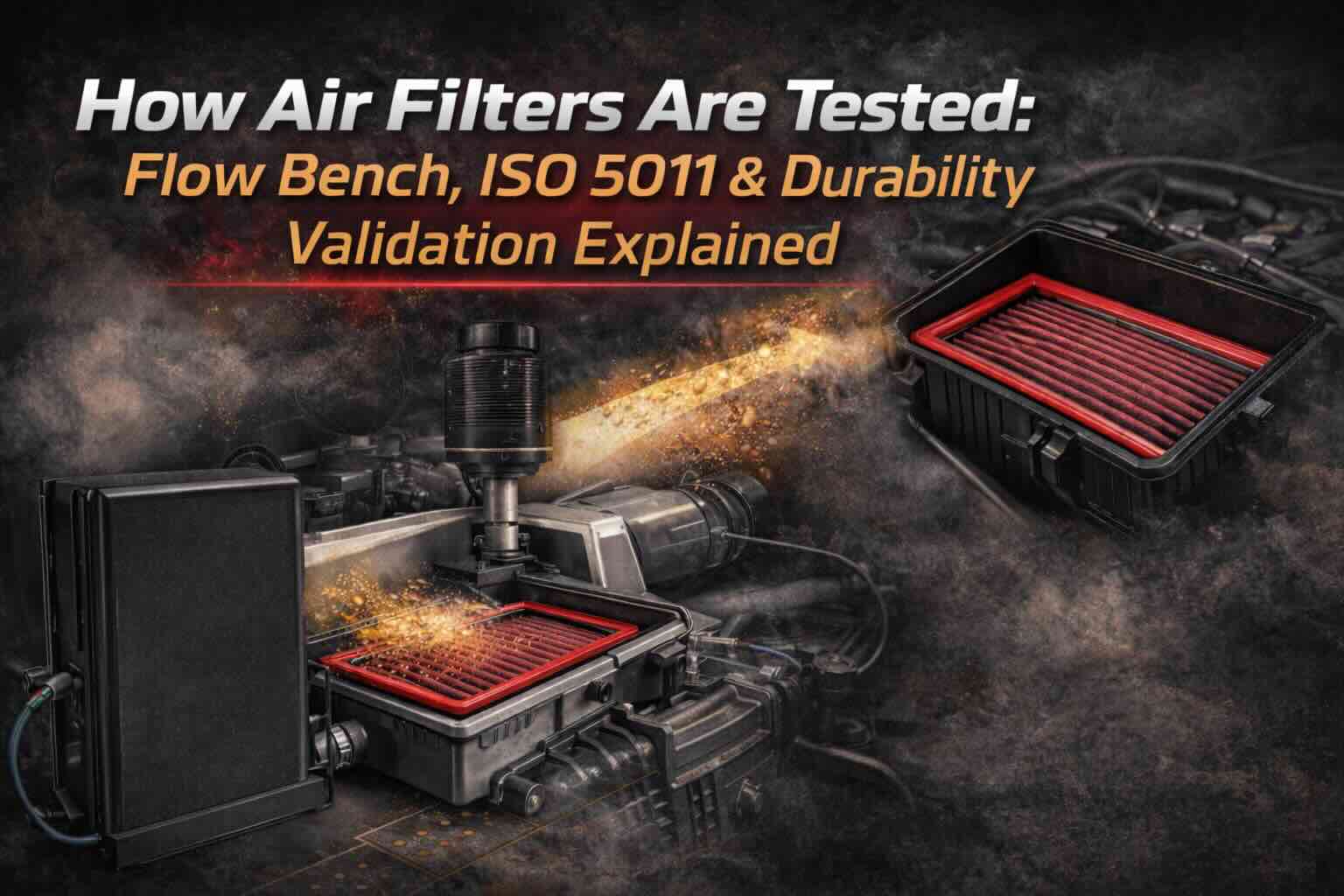
Flow bench testing: what it proves (and what it can’t)
Flow benches measure airflow and pressure drop under controlled conditions. They’re useful for comparing restriction curves when mounting and sealing are controlled.
- Proves: restriction differences (ΔP) at given flow rates; repeatability when fixtures are consistent.
- Does not prove: horsepower gains (requires dyno), filtration efficiency (requires ISO-style methods), dust capacity, or long-term durability.
Want the full test breakdown with standards context? Read: Flow bench + ISO 5011 + durability testing explained
Dyno methodology: how to validate gains correctly
If someone says “verified horsepower on a flow bench,” you can safely file that under: nope. Horsepower must be validated on an engine dyno, chassis dyno, or controlled road testing with repeatable logging.
Dyno checklist (the difference between data and noise)
- Control IAT: intake temperature drift will swamp small gains.
- Manage heat soak: same cooldown, same run order, same fan positioning.
- Stabilize trims: ensure fueling is consistent across runs.
- Multiple pulls: average results; ignore “best pull wins” games.
- Same configuration: no “oops we changed two things at once.”
A drop-in filter is typically a small delta. Small deltas demand strict test control.
Turbo engines: compressor efficiency and inlet restriction
Turbocharged engines can be more sensitive to inlet restriction because the compressor must work harder to achieve the same mass flow and pressure ratio when inlet pressure is reduced. That can influence compressor operating point (shaft speed, efficiency, temperature rise).
Practically: reducing inlet restriction can improve consistency under sustained boost and help transient response—especially when the vehicle is operating near the upper airflow region of its compressor map.
Related reading (platform examples): Porsche 911 airflow & response analysis | BMW M5 (S63) performance impact
CFD and real intake behavior: why fitment and geometry matter
Intake behavior isn’t just a single CFM number. Real airboxes have turns, expansions, contractions, resonators, and surfaces that create turbulence and non-uniform flow distribution. CFD work in intake systems regularly shows that geometry and sealing can matter as much as media choice.
- Pleat geometry: affects boundary layer behavior and local velocity gradients.
- Frame stiffness and sealing: prevents bypass air that can invalidate “flow” and reduce protection.
- Airbox design: can be the limiting factor, not the filter.
If you’re running a well-designed OEM airbox, a high-quality drop-in filter is often the most sensible upgrade path. Why the factory airbox beats most aftermarket intakes
Expected results by engine type
Let’s set expectations like adults. Drop-in performance filters are typically small deltas. Here’s what people most often observe when testing is controlled:
| Platform type | Most common outcome | Where gains show up |
|---|---|---|
| Stock NA daily drivers | Often small or unmeasurable peak gains | Response consistency, high RPM |
| High-output NA | Sometimes measurable gains | Top-end, repeated pulls |
| Turbo performance | More likely to improve consistency | Sustained boost, transient response |
Where BMC fits (testing + real-world use)
BMC’s “fitment + repeatability” philosophy is the boring engineering answer that wins long-term: stable geometry, consistent sealing, and predictable airflow behavior. The goal isn’t just clean flow—it’s repeatable performance with protection and durability.
That’s also why BMC products appear in high-performance road and motorsport environments where sustained load, vibration, and heat cycling expose weak designs quickly. Motorsport use isn’t a magic horsepower guarantee on your exact car, but it does put strong pressure on consistency and reliability.
Explore by platform: Porsche, BMW, Ferrari, Lamborghini.
FAQ
Do performance air filters really increase horsepower?
They can, but only if the factory filter or airbox is a restriction at the tested airflow. Most drop-in gains are modest and require controlled dyno validation.
Why do some people feel a difference even when dyno gains are small?
Reduced restriction can change transient response and consistency under repeated pulls. Seat-of-the-pants feel can come from throttle mapping, sound, and small airflow changes that do not always show as big peak horsepower.
Do turbo cars benefit more?
Often yes. Turbo compressors can be sensitive to inlet restriction, affecting shaft speed and efficiency. Real-world improvements commonly show up as consistency under sustained boost rather than huge peak numbers.
Is “more airflow” always better?
No. You need balanced performance: restriction, filtration efficiency, dust capacity, and structural durability. That’s why ISO 5011-style evaluation matters.
How often should I clean or replace a performance filter?
Use inspection-based intervals that match your environment. For reusable filters, follow proper cleaning and re-oiling procedures to maintain efficiency and avoid over-oiling issues.
Maintenance guide: How to wash & re-oil
Final verdict
Performance air filters don’t “make horsepower” by magic. They reduce restriction. If restriction is limiting airflow at the operating point you’re testing, you can see measurable gains. If the OEM system already flows well, you’ll usually see small changes—often more consistency than peak power.
If you want an OEM-quality, fitment-correct solution, start with vehicle-specific options: Shop BMC replacement filters or contact us for fitment confirmation.

Leave a comment
This site is protected by hCaptcha and the hCaptcha Privacy Policy and Terms of Service apply.