


Summary:
Finding the correct BMC air filter for a European performance car is not something you want to guess at. Many vehicles share similar model names, engines, chassis codes, and airbox layouts, but that does not always mean they use the same filter. The correct BMC part number can depend on year, engine, chassis, trim, market, production split, and whether the vehicle uses one filter, two filters, or a complete filter kit.
This guide explains how to choose the right BMC washable replacement air filter before ordering. It covers vehicle fitment, BMC part numbers, OEM cross references, engine and chassis details, single-filter versus two-filter applications, and when it makes sense to contact European Performance Filters for help. The goal is simple: help you order the correct filter the first time.
A BMC air filter can be a smart OEM-style upgrade for many European cars because it keeps the factory airbox, supports strong airflow, and gives owners a washable, reusable alternative to disposable paper filters. The key is making sure the filter actually matches the vehicle.
Table of contents:
- Why BMC air filter fitment matters
- Start with the correct vehicle details
- Using the BMC part number
- Using OEM cross reference numbers
- Single filter vs two filters required
- Why chassis, engine, and airbox details matter
- Shop BMC filters by vehicle brand
- What to check before ordering
- Frequently asked questions
- What to remember before ordering
Why BMC air filter fitment matters
Most European performance cars are not simple one-size-fits-all vehicles. A Porsche 911, BMW M car, Audi RS model, Ferrari, Lamborghini, Mercedes-AMG, or McLaren may have multiple engines, chassis generations, intake layouts, and production changes across what looks like the same model family.
That is why air filter fitment matters. The filter has to seal correctly inside the airbox, match the shape of the factory filter housing, and be the correct BMC part number for that specific application. A filter that looks close is not good enough. If it does not seat properly, the intake system may not be protected the way it should be.
The safest approach is to confirm the filter by vehicle details, BMC part number, and OEM cross reference when possible. That extra minute of checking can save a wrong order, a return, or a filter that simply does not belong in the car.
Start with the correct vehicle details
The best place to start is with the complete vehicle information. For most BMC replacement air filters, you should confirm:
- Year
- Make
- Model
- Engine size
- Trim or performance model
- Chassis code when available
- Market or region if the vehicle is imported
- Factory airbox configuration
For example, searching only “BMW M3 air filter” is not always specific enough. A BMW E46 M3, E92 M3, F80 M3, and G80 M3 are very different cars. The same logic applies to Porsche 911 generations, Audi RS models, Ferrari V8 and V12 platforms, Lamborghini models, and Mercedes-AMG applications.
If you already know the BMC part number, that is helpful. If you do not, start with the vehicle collection and narrow down from there.
Using the BMC part number
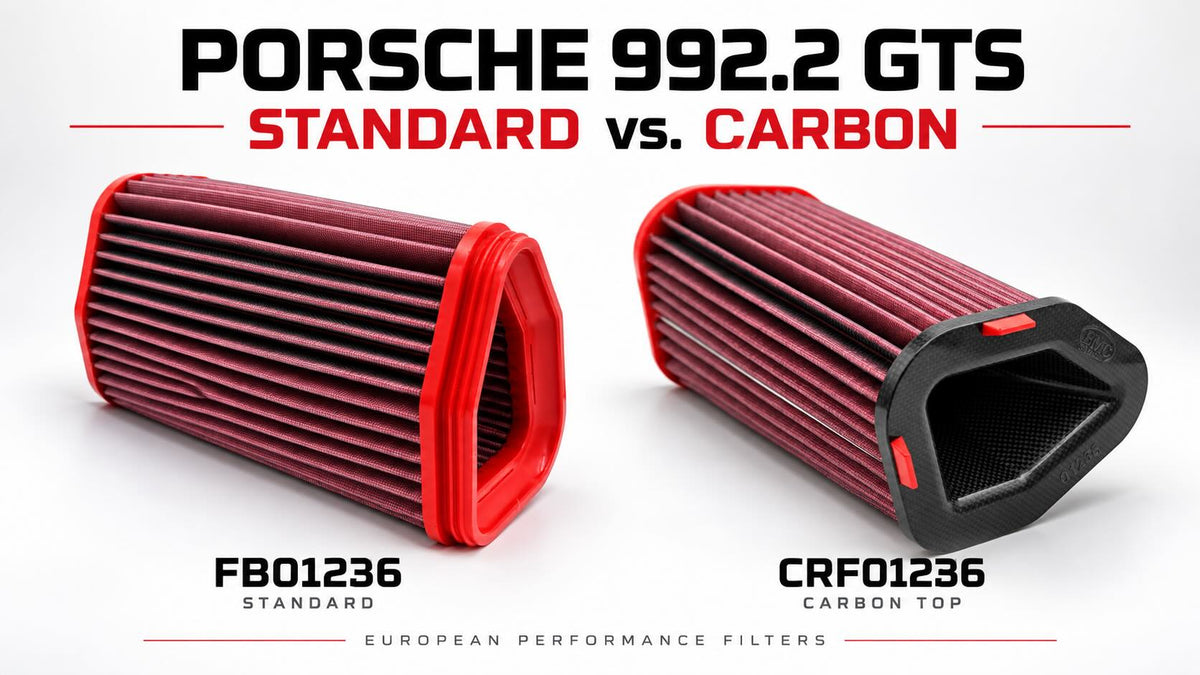
The BMC part number is one of the most important pieces of fitment information. BMC replacement filters are commonly listed with part numbers such as FB01023, FB01118, FB487/20, FB798/20, FB926/20, and many others. These part numbers identify the actual filter or filter kit, not just the vehicle brand.
If you already have a BMC part number, use it to search directly. This is especially useful if you are replacing an existing BMC filter, comparing a catalog listing, or confirming a filter that was recommended by a shop or dealer.
When reviewing a product page, do not stop at the title. Check the visible fitment table, application notes, engine notes, OEM cross references, and whether the product is sold individually or as a full kit. The product title may highlight the highest-volume applications, while the fitment table carries the deeper application detail.
Using OEM cross reference numbers
OEM cross reference numbers can be extremely helpful when confirming a replacement air filter. The OEM number is the factory air filter part number used by the vehicle manufacturer. If the OEM number on your original filter, parts diagram, or service information matches the cross reference listed on an EPF product page, that is a strong fitment clue.
That said, OEM cross references should still be used carefully. Some manufacturers update part numbers, supersede old numbers, or use different references depending on production date, region, or engine variation. The OEM number is useful, but it should be checked alongside the vehicle application.
A good fitment check usually combines three pieces of information:
- The vehicle details
- The BMC part number
- The OEM cross reference number
When those line up, you are much closer to the correct filter.
Single filter vs two filters required
This is one of the easiest details to miss. Some vehicles use one air filter. Some use two. Some BMC listings are sold as a complete two-filter kit, while others are sold individually and require two filters for a complete service.
That difference matters at checkout. If the vehicle requires two filters and the product is sold individually, you may need to order quantity two. If the BMC part number is a full kit that includes two filters, ordering two kits would usually be unnecessary.
European performance cars with larger engines, dual airboxes, or left/right intake layouts commonly use two filters. This can apply to certain Porsche, BMW M, Audi RS, Ferrari, Lamborghini, Mercedes-AMG, McLaren, Aston Martin, Bentley, Maserati, and other high-performance applications.
Before ordering, always check the product page notes for wording such as:
- Sold individually
- Two filters required
- Full kit includes two filters
- Left and right filter
- Confirm quantity before ordering
This is not the glamorous side of performance car ownership, but it is the part that keeps you from opening the box and immediately inventing new swear words.
Why chassis, engine, and airbox details matter
European manufacturers reuse model names for years, but the hardware underneath can change dramatically. A Porsche 911 alone spans multiple generations with different intake layouts. BMW M models change by chassis and engine family. Audi RS vehicles may share engines with other VW Group performance models, but the airbox details still need to be confirmed. Ferrari and Lamborghini applications can also vary by model year, market, and intake configuration.
That is why chassis codes and engine families matter. They help separate vehicles that look similar in search results but use different parts in the real world.
Examples of details that can affect air filter fitment include:
- Porsche 911 generation, such as 997, 991, or 992
- BMW chassis codes, such as F80, F90, G80, G82, or G87
- Audi chassis and model family, such as C8 RS6/RS7 or 4M Q7/Q8
- Ferrari model and engine family
- Lamborghini platform and engine configuration
- Mercedes-AMG engine and model generation
- Whether the vehicle uses one airbox or two
A BMC washable replacement air filter is designed to work as an OEM-style replacement when the correct part number is selected. The fitment check is what makes the upgrade clean instead of frustrating.
Shop BMC filters by vehicle brand
If you are not starting with a BMC part number, the easiest path is to browse by vehicle brand and then narrow down by model, engine, and year.
- Shop Porsche BMC air filters
- Shop BMW BMC air filters
- Shop Audi BMC air filters
- Shop Ferrari BMC air filters
- Shop Lamborghini BMC air filters
- Shop Mercedes-Benz and AMG BMC air filters
- Shop McLaren BMC air filters
- Shop Aston Martin BMC air filters
- Shop all BMC car air filters
These collection pages are the best starting point when you know the vehicle brand but still need to narrow down the exact part number.
What to check before ordering
Before ordering a BMC air filter, run through this quick checklist:
- Confirm the year, make, model, and engine.
- Check the chassis code or platform when available.
- Compare the listed BMC part number to your application.
- Review the product fitment table and notes.
- Check whether the product is sold individually or as a complete kit.
- Compare OEM cross reference numbers when available.
- Confirm whether your vehicle uses one filter or two.
- Ask EPF for help if the application is unclear.
If anything does not line up, it is better to ask before ordering. Fitment questions are normal, especially on European performance vehicles with multiple engines, production splits, and airbox variations.
Contact European Performance Filters for fitment help
Frequently asked questions
How do I know which BMC air filter fits my car?
Start with your year, make, model, engine, and chassis code if available. Then compare the listed BMC part number, fitment table, OEM cross references, and product notes before ordering. If the application is unclear, contact EPF for help confirming fitment.
Can I search by BMC part number?
Yes. Searching by BMC part number is one of the best ways to find a specific filter. This is helpful if you are replacing an existing BMC filter, comparing a catalog listing, or confirming a recommendation from a shop.
Can I use an OEM part number to find a BMC filter?
Yes, OEM cross references can help identify the correct BMC replacement filter. However, OEM numbers should still be checked against the vehicle application because part numbers can vary by production date, market, engine, or airbox configuration.
Do all European cars use one air filter?
No. Some vehicles use one filter, while others use two. Some BMC products are sold as full kits, and others are sold individually where two filters may be required. Always check the product notes before ordering.
Do I need ECU tuning with a BMC replacement air filter?
No ECU tuning is required for a standard BMC replacement panel filter when it is used in the correct compatible application. It is designed as an OEM-style replacement filter for the factory airbox.
Are BMC air filters washable and reusable?
Yes. BMC replacement filters are washable and reusable when serviced with the proper BMC cleaning and re-oiling kit. New BMC filters come pre-oiled and ready to install, so do not add extra oil before first use.
What should I do if I am not sure which filter fits?
Contact European Performance Filters before ordering. Include your year, make, model, engine, VIN if available, and any OEM air filter part number you have. That makes it much easier to confirm the correct BMC part number.
What to remember before ordering
The right BMC air filter is the one that matches your specific vehicle, engine, chassis, and airbox configuration. That sounds simple, but it is where many wrong orders happen. Modern European performance cars often have multiple engine options, production splits, and intake layouts hiding under similar model names.
A washable BMC replacement air filter can be a strong choice for owners who want a premium, reusable, OEM-style filter upgrade while keeping the factory airbox. The important part is confirming the correct BMC part number before ordering.
Use the vehicle details, BMC part number, OEM cross references, product notes, and quantity information together. If something looks unclear, contact European Performance Filters before placing the order. A clean fitment check up front is a lot easier than dealing with the wrong filter later.
Contact European Performance Filters for fitment help

Leave a comment
This site is protected by hCaptcha and the hCaptcha Privacy Policy and Terms of Service apply.