

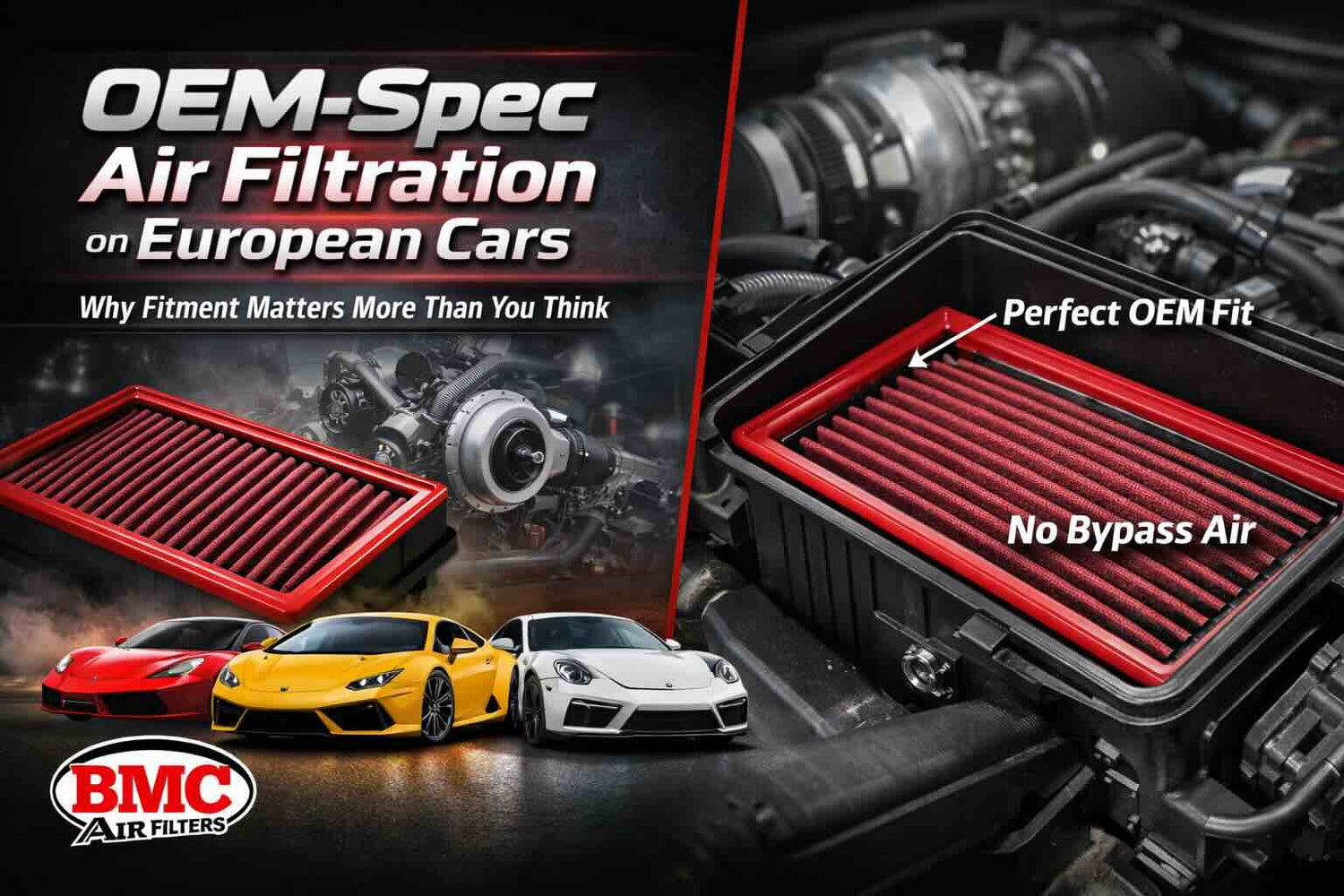
Summary: European intake systems are engineered as a complete package—airbox, filter, sealing surfaces, and metering strategy. “It fits” isn’t the same as OEM-spec fitment. The right filter must seal evenly, maintain consistent geometry, and deliver repeatable airflow behavior over time, especially on modern turbocharged platforms.
- OEM-spec fitment helps prevent bypass (unfiltered) air and keeps filtration predictable.
- European MAF/load strategies benefit from stable, repeatable airflow characteristics.
- Turbo engines magnify both restriction and sealing issues under sustained demand.
- BMC’s OEM-grade approach is rooted in controlled manufacturing, molded frame design, and repeatable fitment.
OEM-Spec Air Filtration on European Cars: Why Fitment Matters More Than You Think
European engines don’t “kind of” like correct air filtration—they depend on it. Between tight packaging, sensitive metering strategies, turbocharger airflow demands, and increasingly aggressive emissions control, the intake tract on a modern European car is engineered like a system, not a suggestion.
That’s why “it fits” isn’t the same as OEM-spec fitment—and why the quality of the seal, frame geometry, and repeatable airflow behavior matters as much as the filter media itself.
This article explains what OEM-spec fitment actually means, what goes wrong when it’s off, and why BMC Air Filters are widely described as OEM-grade in design and fitment without pretending every other option is junk.
What “OEM-Spec Fitment” Really Means
When an OEM designs an airbox and filter, they’re balancing multiple goals at once:
- Consistent airflow with predictable pressure drop across the filter’s service life
- High filtration efficiency under dusty load conditions
- Sealing integrity with no bypass air around the filter
- Durability under heat cycles, vibration, and chemical exposure
- Packaging tolerances that don’t tolerate “almost the right size”
An aftermarket filter can be made from great materials and still cause issues if the frame geometry or seal behavior is off by just a little.
BMC emphasizes a molded, one-piece frame construction, often referred to as “Full Moulding,” intended to maintain sealing consistency and long-term durability inside OEM airboxes.
Why European Airboxes Are Less Forgiving Than Most People Think
1) Airbox sealing matters because bypass air is unfiltered air
If the frame doesn’t compress correctly against the airbox, air will take the easy path. That means unfiltered bypass air, which defeats the entire point of filtration.
Even small leaks can accelerate wear over time, especially on cars that see track days, dusty roads, or frequent high-load operation.
What to look for: a filter frame that matches the OEM sealing surface and compresses evenly without warping or floating in the housing.
2) MAF / load calculations rely on stable flow characteristics
Modern ECUs don’t just measure air and move on. They learn. They adapt. They cross-check.
A filter that changes flow characteristics unpredictably, or leaks around the edges, can create conditions where:
- fuel trims drift more than expected
- airflow readings become noisier
- drivability consistency suffers, especially during transient throttle
This is one of the reasons OEM-style fitment isn’t about perfectionism. It’s about system stability.
3) Turbo engines amplify the consequences of restriction and leaks
Turbo cars move a lot of air, and they do it across wide operating ranges.
- Too much restriction can increase compressor work for the same mass flow
- Poor sealing raises ingestion risk, especially under sustained boost
This is why OEM-level engineering for air filtration is a bigger deal on European turbo platforms than it was on older naturally aspirated setups.
The Quiet Truth: “Performance” Isn’t Just More Flow — It’s Repeatable Flow
A lot of marketing focuses on more airflow. That’s only half the story.
Repeatable airflow is what matters: stable pressure drop, stable seal compression, stable filtration behavior, and stable results after service.
BMC references testing aligned with recognized filtration standards, including ISO-style methods, which is important because it anchors performance claims in controlled, comparable conditions instead of “trust me” airflow numbers.
Learn more about BMC filtration testing and technology
Why BMC Is Often Described as “OEM Quality”
Here’s the unbiased version: BMC is closely associated with OEM and motorsport programs, which tends to demand dimensional control, repeatability, and durability.
OEM involvement and partnership signals
BMC publicly discusses OEM-level supply and partnerships within high-performance and motorsport environments. The practical takeaway is simple:
BMC designs and manufactures with standards that must hold up to scrutiny, and that discipline typically shows up in replacement filters as fitment consistency and long-term reliability.
Motorsport heritage
Motorsport doesn’t automatically equal OEM road-car supply, but it does force a manufacturer to live at the intersection of filtration, airflow consistency, and reliability. That mindset matters when the product is expected to fit and perform like an OEM part.
Fitment: The Most Underrated Performance Feature
Here’s what excellent fitment actually gives you:
- Better seal → less bypass air → better protection
- Consistent airflow path → more stable metering and trims
- More predictable maintenance outcomes after cleaning and oiling
- Less chance of frame deformation over heat cycles
- Less weirdness like rattles, warping, or filter shifting in the housing
If you’ve ever opened an airbox and seen dust trail patterns downstream of the filter edge, that’s usually a sealing or seating problem, not bad luck.
Common Fitment Problems
Problem 1: Frame too stiff or too soft
- Too stiff: won’t compress, leaks at corners
- Too soft: compresses unevenly, can shift in the housing over time
Problem 2: Poor dimensional control
The filter drops in but doesn’t actually seat with even compression.
Problem 3: Inconsistent edge geometry
The airbox lid torques down, but the filter edge floats in sections.
OEM-style molded frames are one of the simplest ways to reduce these issues because they support consistent geometry and sealing behavior over time.
How to Choose the Right Filter for Your European Car
If you want OEM-spec behavior, use this checklist:
- Direct-fit, vehicle-specific design with no trimming and no universal nonsense
- Uniform sealing surface, especially at corners and transitions
- Recognized filtration standard references, because ISO-style testing is a good sign
- Serviceability done right, meaning clean and re-oil per manufacturer guidance
- Buy from a source that knows fitment, because part-number mistakes happen
Recommended Links
- BMC Air Filters for Porsche
- BMC Air Filters for Ferrari
- BMC Air Filters for Lamborghini
- How to clean and re-oil a BMC filter correctly
- Need help verifying fitment? Contact us.
FAQ
Why does OEM-spec fitment matter so much on European cars?
European intake systems are tightly engineered around specific airbox dimensions, sealing surfaces, and airflow behavior. Even a small fitment issue can create bypass air, unstable airflow readings, or inconsistent drivability.
What happens if an air filter does not seal correctly?
If the filter does not seal evenly, unfiltered air can bypass the media and enter the engine. That reduces the effectiveness of the filter and can increase long-term wear, especially in dusty or high-load driving conditions.
Why are turbocharged European cars more sensitive to filter fitment?
Turbo engines move more air across a wider operating range, so both restriction and sealing problems become more significant. A poor-fitting filter can increase compressor workload or raise the risk of ingestion from bypass air under sustained boost.
Is more airflow always better in an aftermarket filter?
No. Airflow only matters if it remains stable, repeatable, and properly sealed. A filter that flows well on paper but fits poorly or behaves inconsistently in the airbox can create more problems than it solves.
What should I look for in a replacement air filter for a European car?
Look for vehicle-specific fitment, even seal compression, controlled frame geometry, recognized filtration test references, and proper serviceability. Good fitment is not a bonus feature. It is part of the filter doing its job correctly.
Bottom Line
If you’re upgrading a European platform, treat the air filter like a precision component, not a generic maintenance item. OEM-spec fitment is what keeps airflow consistent, sealing correct, and filtration doing its job.
Browse BMC filters by your vehicle, or reach out and we’ll help you confirm the correct part number before you order.



Leave a comment
This site is protected by hCaptcha and the hCaptcha Privacy Policy and Terms of Service apply.