

Quick links: BMC BMW F90 M5 Filters · All BMW Applications · All BMC Filters · BMC Cleaning Kit · Installation Guide
Table of Contents
- What Your BMW M5’s S63 Actually Breathes
- Airflow, Pressure Drop & Pumping Losses
- How Restriction Affects Horsepower & Torque
- Throttle Response & Transient Airflow
- Fuel Economy & Long-Trip Efficiency
- The BMC Engineering Approach for BMW M
- Maintenance, Service Life & Cost
- FAQ
- Sources
1) What Your BMW M5’s S63 Actually Breathes
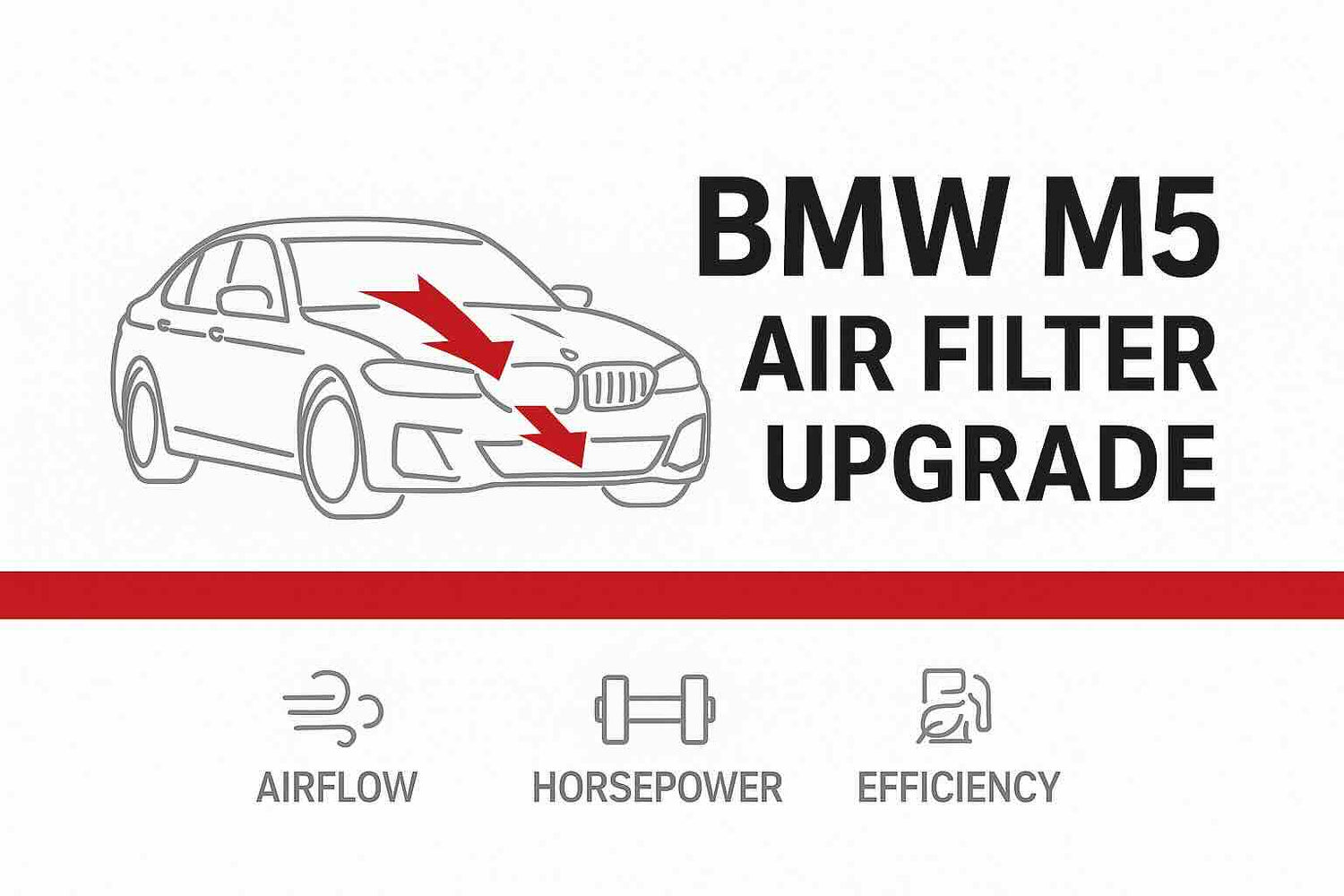
The F90 M5’s S63 is a 4.4L hot-V twin-turbo V8. At full tilt, it’s moving a huge volume of air through the airbox, filters, turbo inlets, intercoolers and intake runners. The air filter’s job is to minimize pressure loss while capturing fine particulates that would otherwise sandblast the compressor wheels and cylinder walls.
In a high-output turbo engine like the S63, a small change in restriction at higher mass flow (think 500–800 CFM across the pair of filters) can alter:
- How quickly boost comes in (spool and torque fill)
- Peak horsepower at the top of the rev range
- How hard the turbos have to work for a given load (pumping losses)
- Fuel economy during steady-state cruising
2) Airflow, Pressure Drop & Pumping Losses
Pressure drop is the resistance the filter imposes on the intake stream. The more the filter “chokes” airflow, the more vacuum you see upstream of the turbo inlets, and the more work the compressors must do to reach the same manifold pressure.
In like-for-like panel filters designed for the BMW M5 airbox, modern oiled cotton gauze elements such as BMC typically show lower restriction than dense OEM paper, especially as the filter accumulates dust. That means less pumping work, less effort for the turbos, and more of the engine’s output going to the wheels instead of fighting its own intake system.

3) How Restriction Affects Horsepower & Torque
When intake restriction rises, the S63’s turbos must run a higher pressure ratio to achieve the same manifold pressure. That extra work shows up as heat and pumping loss. Drop the restriction, and you reduce that wasted effort.
On the dyno, a lower-restriction filter like BMC typically shows:
- A small but repeatable gain in peak horsepower at the top of the rev range
- More consistent power when making multiple back-to-back pulls
- A flatter and cleaner torque curve as boost control becomes less constrained by intake vacuum
For a stock-tune F90 M5, it’s realistic to see an indicative increase of ~5–7 hp at the crank near the top of the powerband, with torque holding a bit stronger before tapering off. You won’t suddenly unlock “tune-level” gains from a filter alone—but you are reclaiming power that would otherwise be lost to restriction.
4) Throttle Response & Transient Airflow
Response is about how quickly the intake system can deliver additional mass flow when you crack the throttle. When the filter presents less resistance, the initial ramp in airflow is steeper, and the ECU doesn’t have to work as hard to hit the requested torque target.
In practice, that shows up as:
- Sharper tip-in in Comfort and Sport modes
- More predictable torque in M Dynamic Mode
- Less “soft” feeling at part-throttle when rolling into boost

5) Fuel Economy & Long-Trip Efficiency
Fuel economy gains from an air filter alone are never dramatic—but on a twin-turbo V8 that spends a lot of time at light load on the highway, reducing pumping losses does add up. When the engine can maintain load with slightly less throttle opening and slightly less turbo effort, you see small, cumulative improvements.
On a stock M5, it’s realistic to see an indicative improvement of 2–4% in steady-state highway fuel economy with a clean BMC filter compared to a typical OEM paper element over its life.

The key is that this is a supporting benefit: you buy the filter for the airflow and repeatability, and the fuel economy bump is an extra win—especially if you daily drive or road-trip your M5.
6) The BMC Engineering Approach for BMW M
BMC designs its BMW M applications to balance high flow with near-OEM filtration efficiency, which is critical on boosted engines that see high compressor speeds and elevated intake temps.
- Media: Multi-layer cotton gauze with low-viscosity oil balances high flow with fine particle capture.
- Mesh: Epoxy-coated alloy mesh keeps pleats stable through heat cycles and underhood vibration.
- Sealing: Precision-molded frames aim for uniform gasket compression in the M5’s dual airboxes to prevent bypass.
- Filtration: Target is near-OEM efficiency with lower restriction, not a “race only” compromise.
For M5 owners, that means you can safely use a BMC filter on a stock or tuned car without treating it like a disposable track-only part—provided you service it correctly.
7) Maintenance, Service Life & Cost
The M5 uses a pair of filters, and BMW’s recommended replacement intervals stack up quickly in both cost and waste. A reusable oiled-cotton solution reduces long-term expense—if you maintain it properly.
Typical guidance:
- Inspection: Every 10–15k miles (earlier in dusty or track-heavy use).
- Cleaning: Only when visibly dirty or after a heavy season of use.
- Drying: Allow the media to fully dry before re-oiling.
- Oiling: Apply a light, even coat of BMC oil—avoid over-saturation.
Over a 5-year ownership window, replacing OEM paper elements regularly can easily exceed the cost of a BMC set plus a wash kit. That’s why many M5 owners treat BMC as a one-time upgrade rather than a consumable.
Shop now: BMC F90 BMW M5 Filters · All BMW BMC Filters · BMC Cleaning Kit
FAQ
Will a performance air filter add horsepower to my BMW M5?
Expect modest but real gains at the top of the rev range—typically in the ~5–7 hp range at the crank on a stock-tune M5—along with more consistent power when the car is heat-soaked. The bigger everyday benefits are sharper throttle response and smoother torque delivery, not dyno headline numbers.
Can a BMC filter improve fuel economy on the M5?
Yes, but think in terms of a small efficiency bump, not miracles. Reducing intake restriction lowers pumping losses, which can translate to a 2–4% improvement in steady-state highway fuel economy in realistic use. Driving style and conditions still dominate the result.
Is filtration compromised with oiled cotton compared to OEM paper?
When correctly oiled, modern multi-layer cotton gauze achieves near-OEM filtration efficiency while flowing freer than dense paper. The key is proper cleaning and oiling technique—don’t over-saturate the media, and use approved cleaning products such as the BMC wash kit.
How often should I clean and re-oil my BMC filters?
Inspect every 10–15k miles under normal conditions. In dusty or track use, inspect more often and clean when the pleats are visibly loaded. Always let the filter dry completely before re-oiling, and apply a light, even coat rather than soaking the media.
Sources
- BMC official site — media construction, oiling and application data.
- BMW M — BMW M5 S63 platform background and engine architecture references.
- Industry-standard flowbench practice and filtration test methodology (illustrative figures herein reflect typical results for like-for-like panels on turbocharged performance engines).



Leave a comment
This site is protected by hCaptcha and the hCaptcha Privacy Policy and Terms of Service apply.