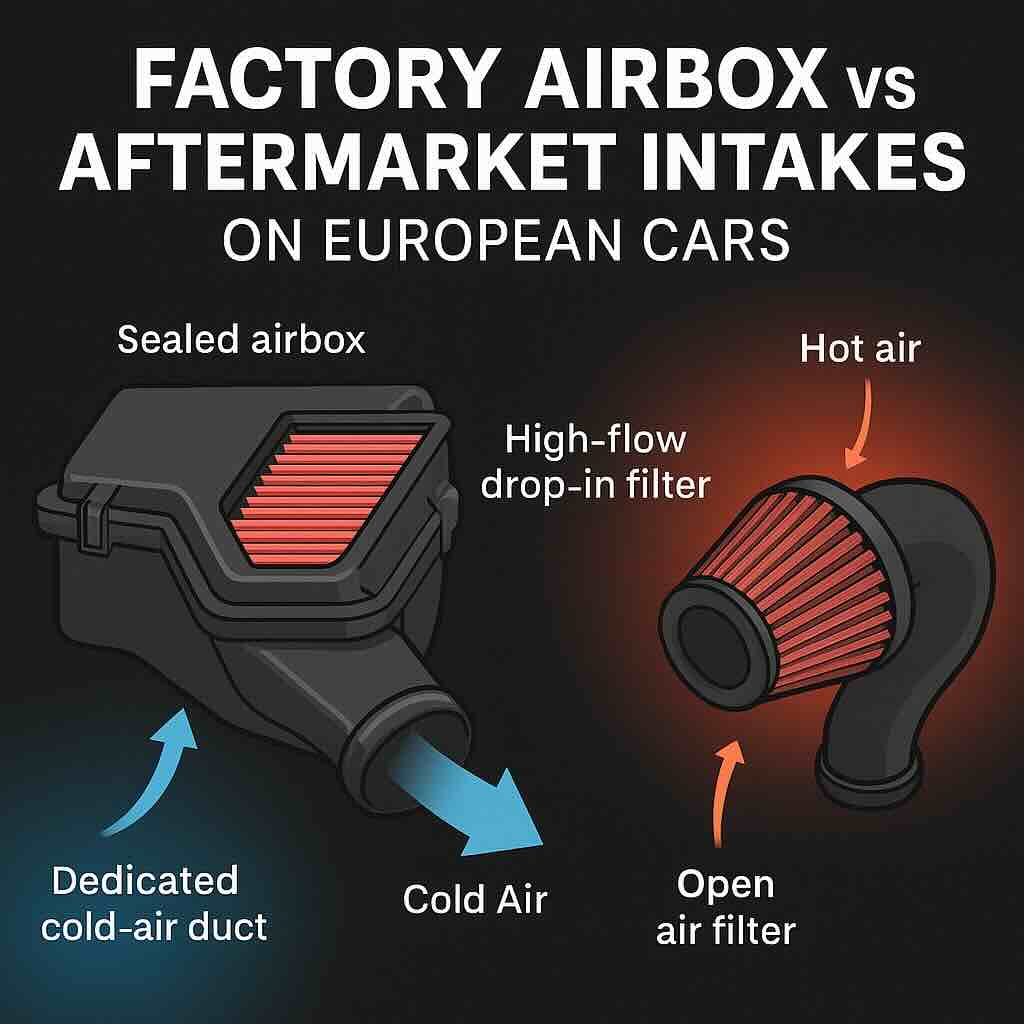
Summary: On modern European performance cars—BMW M, Audi RS, Mercedes-AMG, Porsche, and similar—the factory airbox is not an afterthought. It is a CFD-optimized, thermally managed, pressure-stable system that is often better for power, intake air temperatures (IAT), repeatability, and engine safety than most open cone or “short ram” aftermarket intakes. When you pair that OE box with a high-flow drop-in filter, such as a BMC oiled cotton element, you usually get the best of both worlds: lower restriction with OEM-level control of temperature and airflow.
Quick links: BMW BMC Filters · Mercedes-AMG BMC Filters · Audi RS BMC Filters · Porsche BMC Filters · BMC Cleaning Kit
Table of Contents
- Factory Airbox Engineering: How Modern Euro Cars Are Designed
- The “More Noise = More Power” Intake Myth
- Heat Soak & Intake Air Temperatures (IAT): The Silent Power Killer
- Pressure Stability, Turbulence & MAF Behavior
- ECU Mapping: Why the DME Expects the Factory Airbox
- Dyno Behavior: Why Many Aftermarket Intakes Lose Power
- Drop-In Filters: The Smart Upgrade for Most European Cars
- When an Aftermarket Intake Actually Makes Sense
- Summary & Recommendations
- FAQ
1) Factory Airbox Engineering: How Modern Euro Cars Are Designed
The era of “factory airboxes are restrictive” is mostly over—especially on modern European performance platforms: BMW S55/S58/S63, Mercedes-AMG M177/M178, Audi RS EA839, Porsche 9A2/9A2E engines, and so on. These airboxes are designed alongside the engine using:
- CFD (computational fluid dynamics) to manage airflow velocity and distribution across the filter surface.
- Thermal modeling to keep the airbox isolated from 180–220°F (80–105°C) engine bay temperatures.
- Resonance tuning to control intake noise and pressure waves that can affect drivability.
- Dedicated cold-air ducts that feed the box with high-pressure air from the grille, hood, or fender areas.
In many cases, the factory box will support far more airflow than stock power levels require. It’s common to see OEM airboxes comfortably supporting stage 1 and stage 2 tunes—sometimes approaching or exceeding 600–700+ hp on turbo platforms—without becoming a true restriction. What does become a bottleneck more quickly is the filter element itself and its pressure drop under high flow.

2) The “More Noise = More Power” Intake Myth
One of the biggest reasons aftermarket intakes sell is sound. Induction roar, turbo spool, wastegate flutter—these are addictive and fun. But more sound does not guarantee more airflow or more power.
Many open intakes simply remove the OE airbox lid, add a cone filter, and expose the system to the engine bay. The result:
- More audible turbo and induction noises.
- Minimal or no positive change in actual mass airflow.
- In some cases, less power due to hotter intake air and turbulent flow.
On a modern Euro car, intake noise is often heavily filtered through resonators and ducts to meet NVH targets. When you undo that, you hear more—but what you’re hearing may just be the system working harder, not better.

3) Heat Soak & Intake Air Temperatures (IAT): The Silent Power Killer
Heat management is where the factory airbox almost always wins. A sealed box is physically separated from much of the engine bay heat and is fed by cold air from outside the car. An open intake, on the other hand, lives directly in the under-hood hot zone.
Key realities on modern Euro cars:
- Engine bay temps can climb well above 180–200°F (82–93°C) in traffic or after repeated pulls.
- An open cone can easily see 20–40°F higher IAT than a properly ducted factory box at the same operating point.
- Higher IAT reduces air density and forces the ECU to pull ignition timing and/or boost to protect the engine.
That means you can bolt on a “performance” intake, see no gains on the first pull, and then actually lose power as the system heat-soaks. Meanwhile, the factory airbox—with a less restrictive drop-in filter—keeps IAT under control so the engine can make consistent power over and over.

4) Pressure Stability, Turbulence & MAF Behavior
Modern DMEs (ECUs) are extremely sensitive to intake tract behavior. The factory airbox is designed to deliver:
- Stable, mostly laminar airflow into the MAF/charge pipe.
- Predictable pressure profiles for the turbo compressors.
- Minimal oscillation and surge under transient conditions.
Many aftermarket intakes remove Helmholtz resonators, change tract length, or place the MAF sensor in a different cross-section of the pipe. This can:
- Introduce turbulence at the MAF, leading to noisy or inaccurate readings.
- Trigger fuel trims and knock control corrections as the ECU tries to stabilize mixtures.
- Change compressor inlet pressure behavior enough that boost control strategy must be retuned.
The end result is that without proper calibration, an intake that “looks freer” on the outside can actually make the car feel less consistent and, in some cases, less powerful.

5) ECU Mapping: Why the DME Expects the Factory Airbox
Euro manufacturers tune engines as complete systems. That means the DME maps are built around the specific volume, duct length, and flow behavior of the factory intake system. Change those parameters too much and you are technically outside the design envelope the software expects.
The stock calibration assumes:
- Certain pressure drops at specific flow rates through the intake path.
- Specific MAF transfer functions, if MAF-based, or modeled airflow characteristics, if speed-density-based.
- Known resonance and pressure-wave behavior in the intake runner and airbox volumes.
When you bolt on a generic intake without tuning:
- Load calculation can shift, changing how much timing and boost the engine safely targets.
- Knock control may become more active if IAT climbs or mixtures become less predictable.
- Part-throttle drivability and tip-in can feel less refined, even if WOT looks similar on a dyno graph.

6) Dyno Behavior: Why Many Aftermarket Intakes Lose Power
On a dyno, the pattern is common:
- First pull with a new open intake: power looks similar to stock, sometimes slightly better due to cooler starting temps.
- By the third or fourth pull: IAT has climbed, timing is reduced, and horsepower starts to fall off.
- Back-to-back comparison against a stock box with a high-flow drop-in filter: the sealed box usually wins on consistency and often on peak power as well.
Tuners who spend time testing different intake configurations on European cars frequently report that the best repeatable results often come from:
- Factory airbox retained.
- High-flow drop-in filter installed.
- Cold-air feed and ducting kept intact.
7) Drop-In Filters: The Smart Upgrade for Most European Cars
This is where high-flow drop-in filters like BMC oiled cotton elements shine. Instead of throwing away the engineering that went into the factory airbox, you keep it—and simply reduce the restriction at the filter itself.
Advantages of a quality drop-in filter in a factory box include:
- Lower pressure drop than paper, especially as the filter starts to load.
- Retained cold-air routing and thermal isolation of the OE airbox.
- Stable MAF and ECU behavior, since duct geometry and volume remain unchanged.
- Reusability: the filter can be cleaned and re-oiled, reducing waste and long-term cost.
On many European performance platforms, the practical “best setup” for a street-driven car is: Factory airbox + BMC drop-in filter, optionally paired with a quality tune and exhaust—rather than an exposed cone.
Shop by platform: BMW · Audi · Mercedes-AMG · Porsche
8) When an Aftermarket Intake Actually Makes Sense
There are situations where a well-designed aftermarket intake makes sense on a European car:
- Big turbo or hybrid turbo upgrades where the factory box truly becomes a flow restriction.
- Sealed carbon intakes that retain cold-air ducting and box integrity but increase volume and flow.
- Speed-density tuned setups where airflow modeling is recalibrated by an experienced tuner.
- Track-only cars where noise, NVH, and some IAT tradeoffs are acceptable in exchange for packaging freedom.
The key is that these intakes should be treated as part of a system—paired with proper calibration, heat shielding, and in some cases upgraded ducting. A simple metal pipe and exposed cone sitting over a hot turbo is rarely the optimal solution on a modern European platform.
9) Summary & Recommendations
On modern European performance cars, the factory airbox is not a weak link—it’s a carefully engineered part of the engine’s airflow and thermal management strategy. When you remove it and install an open cone or poorly shielded intake, you often:
- Increase IAT and reduce real-world power.
- Introduce turbulence and MAF noise that the ECU must compensate for.
- Lose the repeatability and consistency that make these cars so refined.
In contrast, keeping the OE airbox and installing a quality high-flow drop-in filter gives you:
- Lower restriction where it matters.
- OEM-grade control of IAT and airflow stability.
- ECU-friendly behavior with no tuning required.
- Long-term savings thanks to a reusable filter that can be cleaned and re-oiled.
If your car is stock or lightly tuned, and you drive it on the street, the smartest intake upgrade on most European platforms is simple: Factory airbox + BMC drop-in filter.
Next steps: Shop all BMC performance air filters or pick up a BMC wash and oil kit to maintain the performance you’ve paid for.
FAQ
Why is the factory airbox often better than an aftermarket intake on European cars?
The factory airbox is usually engineered for stable airflow, controlled intake temperatures, predictable ECU behavior, and strong sealing. Many open aftermarket intakes mainly add noise while giving up thermal control and repeatability.
Do aftermarket intakes always make more power?
No. On many modern European platforms, open or poorly shielded intakes can lose power once heat soak builds. The factory airbox often performs better over repeated pulls, especially when paired with a high-flow drop-in filter.
Why do intake air temperatures matter so much?
Higher intake air temperatures reduce air density and can cause the ECU to pull timing or reduce boost. That means hotter air usually equals less consistent power.
What is the best intake upgrade for a stock or lightly tuned European car?
For most street-driven cars, the smartest upgrade is keeping the factory airbox and installing a quality drop-in filter like a BMC oiled cotton element. That keeps the OEM ducting and heat management while lowering restriction at the filter.
When does an aftermarket intake actually make sense?
It can make sense on big-turbo or heavily modified cars, on properly sealed carbon intake systems, or on tuned setups where the intake is treated as part of a complete calibrated package instead of a bolt-on noise maker.
Technical References & Further Reading
- BMC Air Filters – product construction, material, and application data.
- BMW M – background on modern M engine platforms and technology.
- Mercedes-AMG – technical overviews of AMG performance powertrains.
- Audi RS / VAG technical communities – community dyno results and intake testing discussions.
- Porsche – official information on 911 and other performance engines.


Leave a comment
This site is protected by hCaptcha and the hCaptcha Privacy Policy and Terms of Service apply.